
Harvard develops 3D printing for programmable artificial muscles
A Harvard team created an innovative technique enabling the production of soft, programmable muscles through rotational multimaterial 3D printing.

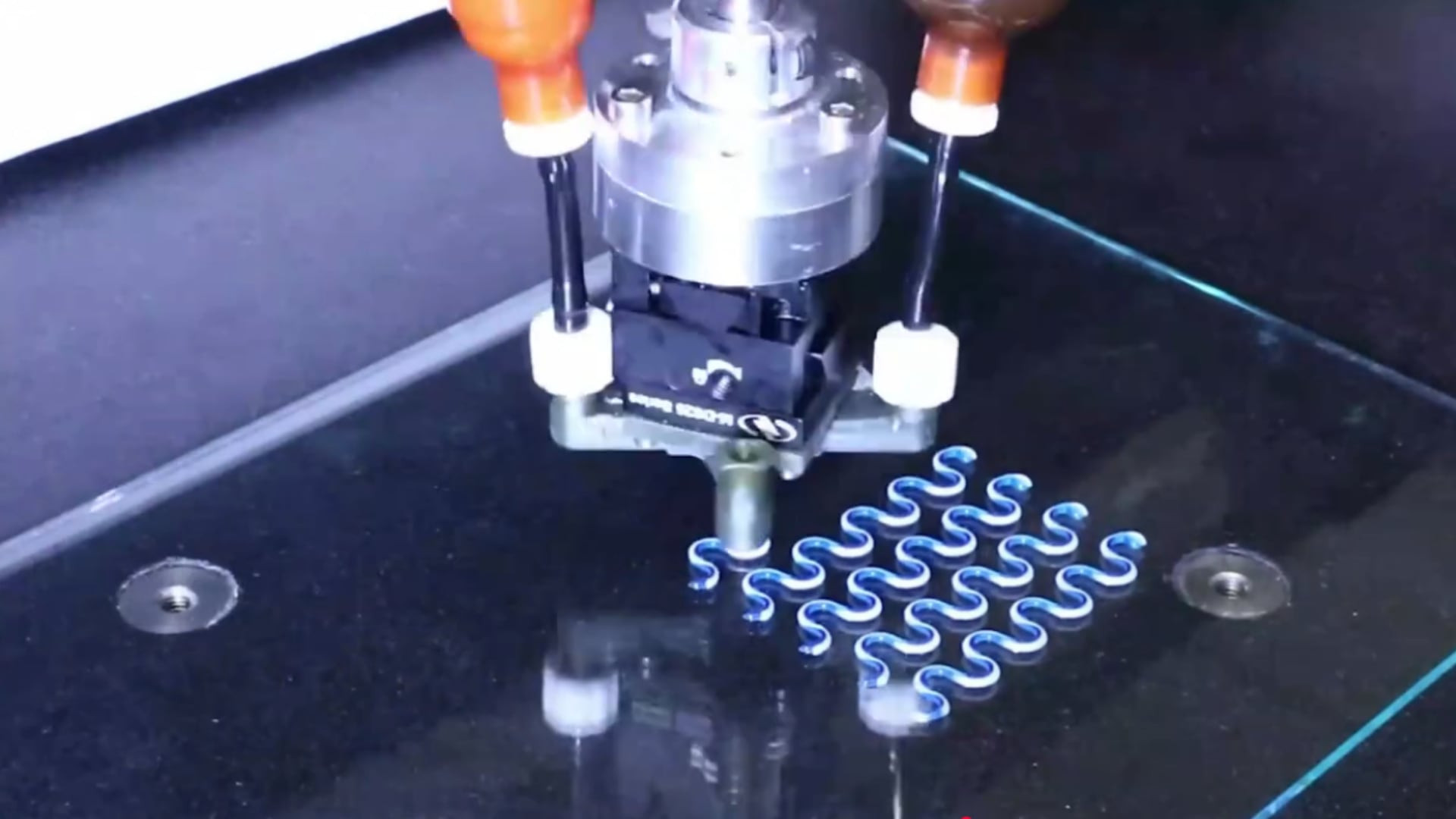
Researchers from Harvard's School of Engineering and Applied Sciences and the Wyss Institute have designed a groundbreaking 3D printing technique that mimics natural structures to create artificial muscles. Inspired by spiral forms found in nature, like vines and elephant trunks, they achieved that synthetic soft materials can perform complex movements such as bending, twisting, and contracting in response to heat stimuli.
The key innovation lies in the rotational multimaterial 3D printing method, which differs from traditional linear processes. Using a rotating nozzle, this technology extrudes and combines two types of materials: an active one, a liquid crystal elastomer (LCE), which contracts when heated, and a passive, soft elastomer that remains inert. The internal helicoidal structure formed during extrusion resembles biological tissues.
When heat is applied, the liquid crystal elastomer contracts, creating tension against the passive elastomer, resulting in predictable movements like bending or twisting without additional mechanical assembly. The rotation speed of the nozzle during printing controls the final shape of the filament once activated, allowing for customized responses tailored to specific needs.
This development opens new avenues in soft robotics and biomedical devices, as these helicoidal filaments can be used to build complex, functional structures like temperature-responsive filters or gripping tools. The programmable architecture transforms simple filaments into sophisticated devices capable of precise movements based on their internal design.
The study, published in PNAS, emphasizes how collaboration between mechanics and molecular alignment experts validated material behavior through advanced techniques such as X-ray scattering, showcasing its potential for robotics and medical applications.
Keep reading online — scan the code
https://go.tricuatro.com/Sp6py
© tricuatro.com
Related articles

Sweet Interstellar Discovery: Erythrulose Detected in the Milky Way
Scientists from the Spanish Astrobiology Center have for the first time identified a true sugar, erythrulose, in a gas and dust cloud near our galaxy's center. This finding suggests complex molecules can form before stars and planets are born.

MIT Chip Converts Invisible Infrared Light into Crucial Data
MIT researchers developed an innovative chip detecting methane and propane using mid-infrared light, with potential for millions of pixels and optical computing.

Tesla Launches Electric Cybertruck Replica for Kids in the US
Tesla introduces its scaled-down Cybertruck for children aged 6 to 12, an electric vehicle priced at USD 1,500, currently exclusive to the US market.
Latest news
View all
Paramount and Warner Bros. Merger Halted by Judge Over Antitrust Concerns
A coalition of 12 states successfully petitioned Judge Araceli Martinez-Olguin to temporarily block the deal, citing fears of higher prices and reduced content.

Assassin's Creed Black Flag Resynced Smashes 3 Million Sales, New Game Plus Announced
Ubisoft's successful re-release of the pirate classic continues to break records, confirming one of the most requested features from the gaming community.

TikTok tests AI tool to protect creators from deepfakes
The video platform is rolling out an opt-in feature allowing users to verify their identity and report unauthorized AI-generated likenesses.
Comments (0)
No comments yet. Be the first!
Only registered readers can comment.