
New tech enables robots to handle complex, irregular objects
Researchers from EPFL and Idiap developed a system that allows robots to manipulate, cut, and peel any object, even in messy environments.

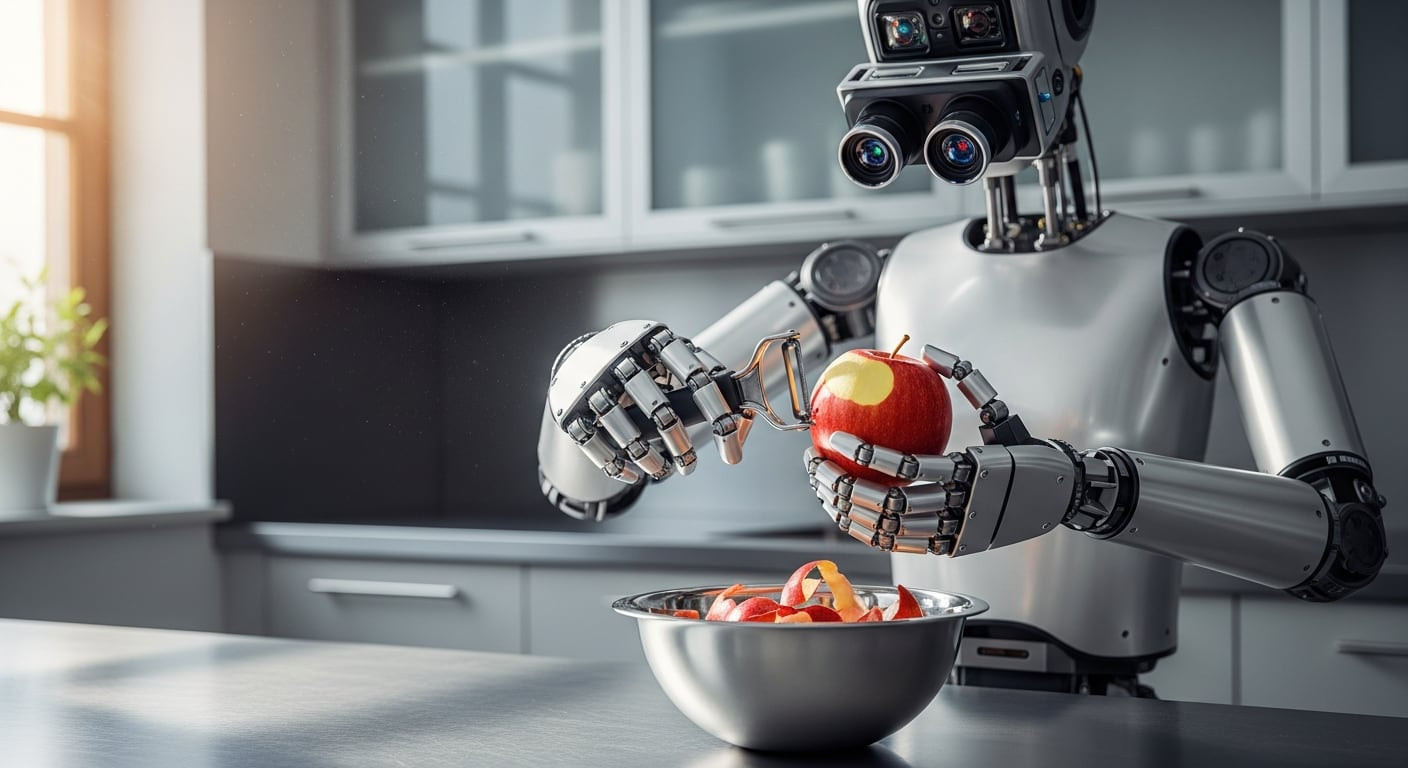
Handling irregular and complex-shaped objects has long been one of the biggest challenges in robotics. Current systems, which rely on large databases and rigid models, struggle to adapt to unpredictable tasks and environments. However, a breakthrough introduced by researchers at the Swiss Federal Institute of Technology in Lausanne (EPFL) and the Idiap Research Institute opens new doors for industrial and service robots.
This new approach enables robots to manipulate, cut, and peel any object, even in cluttered settings with incomplete data. The core of the system is based on adaptable geometry, creating a “point cloud map” of any object regardless of its shape or size. This map identifies key surface points and generates a smooth geometric representation tailored to the task.
As Interesting Engineering reports, this structure helps robots understand and handle objects with varying geometries, overcoming limitations of traditional methods. What’s innovative is that it doesn’t require perfect models or large training datasets. Instead, it uses principles of discrete differential geometry to build local reference frames guided by the surface and key points of the object.
These orientation fields make it possible for robots to perform basic actions—like sliding, cutting, or peeling—invariant to the object’s shape. This allows skill transfer between very different objects, mimicking human flexibility. The technology addresses the variability in geometry that often hampers robotic manipulation.
The system can be integrated with various control schemes, from teleoperation to trajectory planning and reinforcement learning. By generating real-time orientation fields from vision and depth data, robots can quickly adapt to new objects and situations, boosting their efficiency and versatility.
The key to this breakthrough is generating an orientation field from real-time vision and depth data.
Keep reading online — scan the code
https://go.tricuatro.com/OOiVW
© tricuatro.com
Article topics
Related articles

TikTok tests AI tool to protect creators from deepfakes
The video platform is rolling out an opt-in feature allowing users to verify their identity and report unauthorized AI-generated likenesses.

Apple Sues OpenAI Over Alleged Hardware Trade Secret Theft
The Cupertino giant accuses former key employees, including Tang Tan, of stealing confidential hardware information for OpenAI's benefit and its expansion into consumer hardware.

Anthropic Tackles AI's Toughest Questions for a Responsible Future
The company launches an initiative to understand public concerns and transparently address the challenges of artificial intelligence development.
Latest news
View all
Sweet Interstellar Discovery: Erythrulose Detected in the Milky Way
Scientists from the Spanish Astrobiology Center have for the first time identified a true sugar, erythrulose, in a gas and dust cloud near our galaxy's center. This finding suggests complex molecules can form before stars and planets are born.

Paramount and Warner Bros. Merger Halted by Judge Over Antitrust Concerns
A coalition of 12 states successfully petitioned Judge Araceli Martinez-Olguin to temporarily block the deal, citing fears of higher prices and reduced content.

MIT Chip Converts Invisible Infrared Light into Crucial Data
MIT researchers developed an innovative chip detecting methane and propane using mid-infrared light, with potential for millions of pixels and optical computing.
Comments (0)
No comments yet. Be the first!
Only registered readers can comment.