
Webb Telescope Uncovers Millions of Stars in Centaurus A Galaxy
The James Webb Space Telescope has transformed our view of Centaurus A, a nearby and active galaxy, revealing a complex stellar history and the influence of its supermassive black hole.

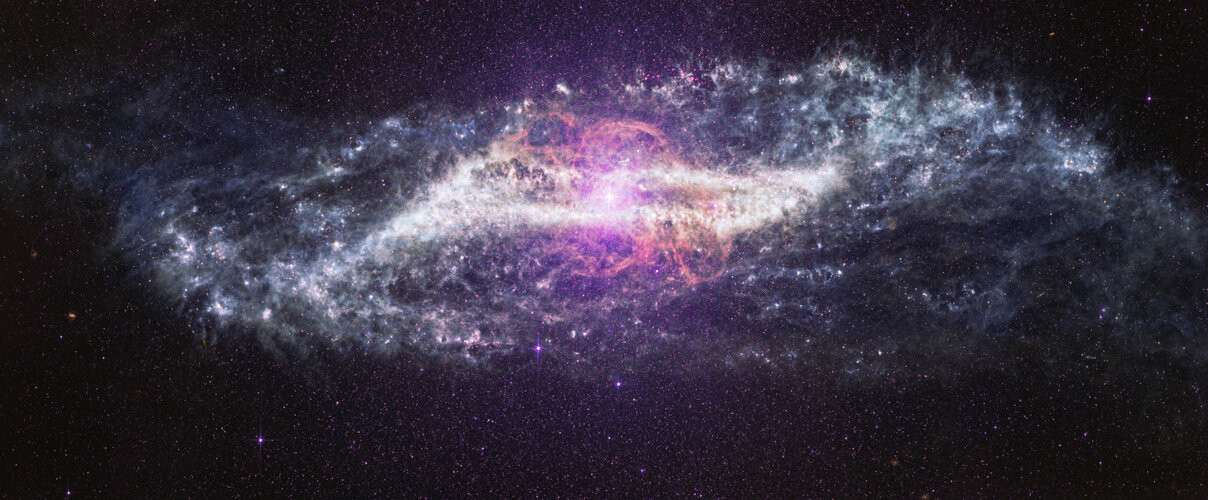
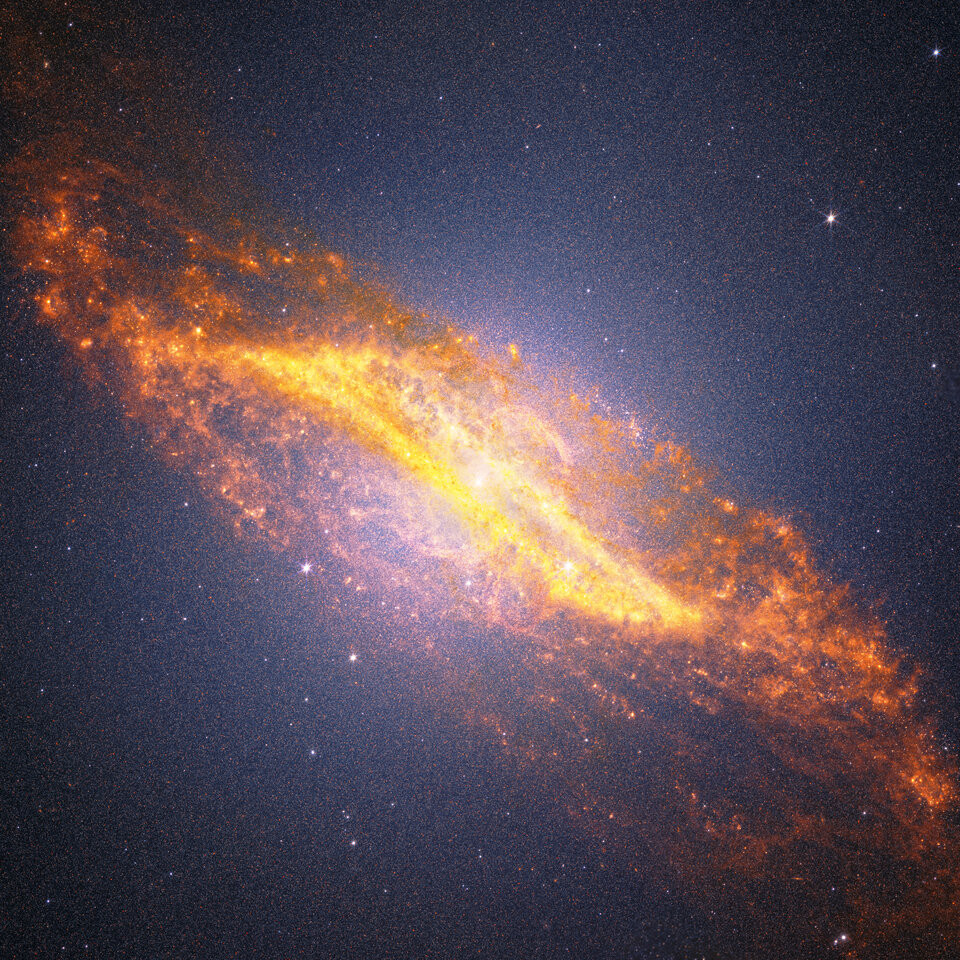
Four years of successful operations have culminated in an unprecedented view: the James Webb Space Telescope (Webb) has revealed millions of individual stars in the Centaurus A galaxy, transforming our understanding of its complex history and evolution. Webb’s unparalleled sensitivity across near- and mid-infrared wavelengths has successfully cut through the thick lanes of dust that, in visible light, obscure Centaurus A’s center, showcasing an incredibly densely packed stellar tapestry and an active, ever-changing galaxy.
Centaurus A, also known as NGC 5128, is located 11 million light-years away from Earth, a relatively close distance in cosmic terms. Unlike most nearby galaxies, Centaurus A is extraordinarily active, making it an ideal cosmic laboratory for understanding how galaxies and black holes grow and evolve together.
At its core, a supermassive black hole actively feeds on surrounding material. This process launches powerful jets and releases enormous amounts of energy, shaping the galaxy around it. Simultaneously, Centaurus A bears the scars of a dramatic past: a major collision with another galaxy approximately two billion years ago. The aftermath of that merger is still visible today in its unusual structure and ongoing star formation.
Webb brings both clarity and depth, exposing the galaxy’s inner workings star by star, where dust previously blocked the view.
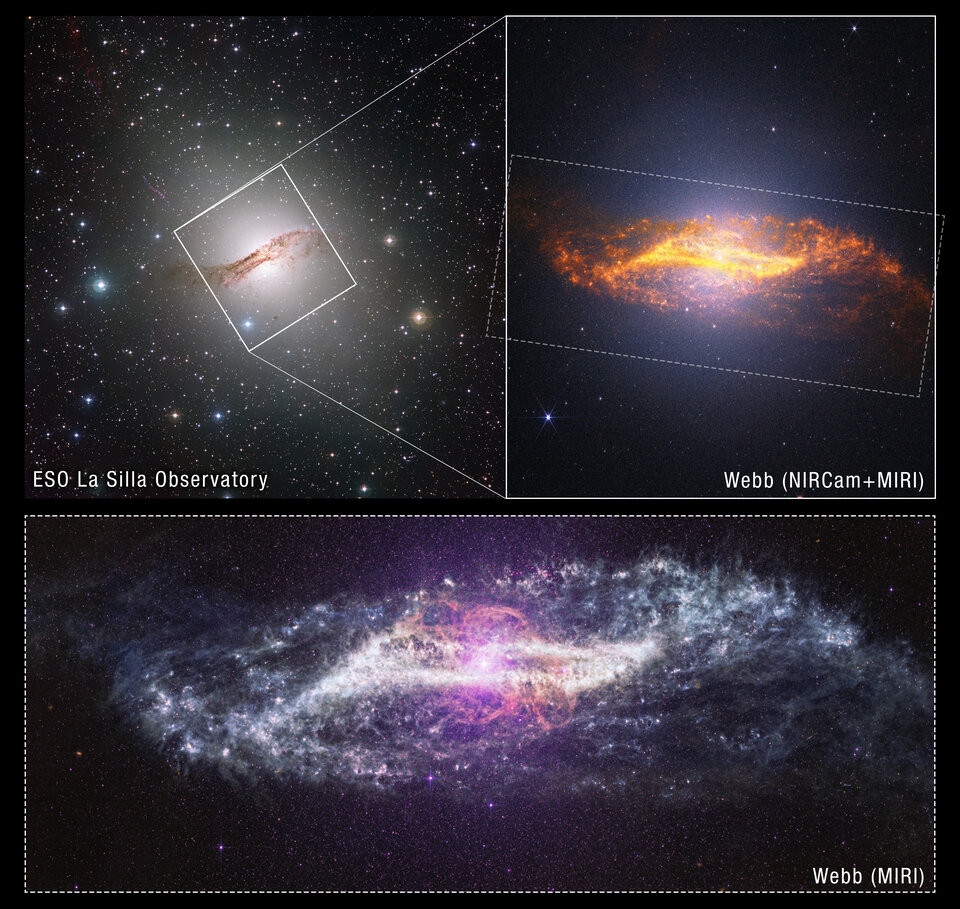
Previous observations, such as those from the NASA/ESA Hubble Space Telescope in visible light, could not reveal the central region due to dust blockage. NASA’s retired Spitzer Space Telescope, while revealing large-scale structures in the infrared, did not resolve individual stars. Now, Webb brings both clarity and depth, exposing the galaxy’s inner workings star by star, where dust previously blocked the view.
Webb’s mid-infrared vision, captured by its MIRI (Mid-Infrared Instrument), highlights the galaxy’s rich dust structures. These glow in intricate shapes that surprise and often perplex astronomers. A warped, parallelogram-like band cuts across the galaxy’s center, while wisps of material stretch outward like cosmic clouds.
An "S" shaped feature, most notable in the MIRI image, is also unusual and prompts questions requiring further study. What created this shape? How does the black hole influence it? Is it influenced by merger-induced star formation? Many of the glowing red points in the MIRI image are dust-rich stars or stellar nurseries, where aging stars are shedding material back into space or new stars are forming. This dust is the essential ingredient for future generations of stars and planets, making it central to the ongoing life cycle of the galaxy.
Thanks to Webb’s high resolution, astronomers can now study Centaurus A star by star, even in its long-obscured central region. What looks "grainy" in the Webb image, most obvious in the combined MIRI and NIRCam (Near-Infrared Camera) view, is actually a densely packed field of individual stars. Together, these stars carry crucial information about the galaxy’s past.
With Webb’s view of Centaurus A, it becomes a genuine case of "galactic archaeology." Each revealed star helps to reconstruct when different events happened: from when older stars first formed, through periods of slowed activity, to a burst of star formation during the collision, and stars born from gas stirred in its aftermath. Collectively, they form a timeline of the galaxy’s evolution.
Webb’s capabilities extend beyond mere imaging. By analyzing light with spectroscopy, astronomers can measure how gas moves within the galaxy. Early findings from Webb show fast-moving ionized gas flowing outward, likely driven by the black hole’s activity, and warmer molecular hydrogen in a warped rotating disk near the center. These observations are key to exploring one of astronomy’s biggest questions: How does a black hole influence an entire galaxy?
The answer appears to be complex. The black hole can both trigger star formation by compressing gas and limit it by pushing material away. Centaurus A offers a rare, nearby view of this intricate cosmic interplay. By tracing dust in never-before-seen detail, resolving millions of stars, and revealing the motion of gas near a supermassive black hole, Webb transforms Centaurus A into a vivid record of cosmic history.
This achievement adds to a fourth year brimming with groundbreaking scientific discoveries. Webb has found new evidence for a planet orbiting Alpha Centauri, showcased eight spectacular gravitational lenses, and mapped the upper atmosphere and auroras of Uranus. Furthermore, it revealed a black hole that formed before its galaxy, and the earliest supernova detected to date, occurring just 730 million years after the Big Bang. These advancements solidify Webb as a fundamental tool for unraveling the mysteries of the universe.
Keep reading online — scan the code
https://go.tricuatro.com/webb-tel
© tricuatro.com
Article topics
Related articles
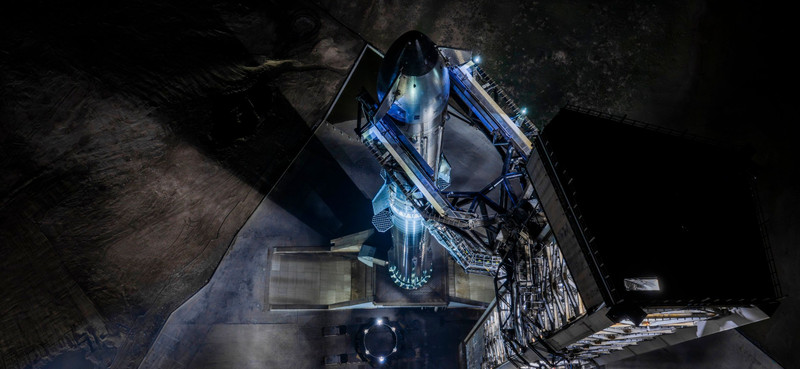
SpaceX Scrubs Starship Test Flight in South Texas
Computer systems detected an anomaly during the Super Heavy booster's engine startup sequence, forcing the mission's abort.
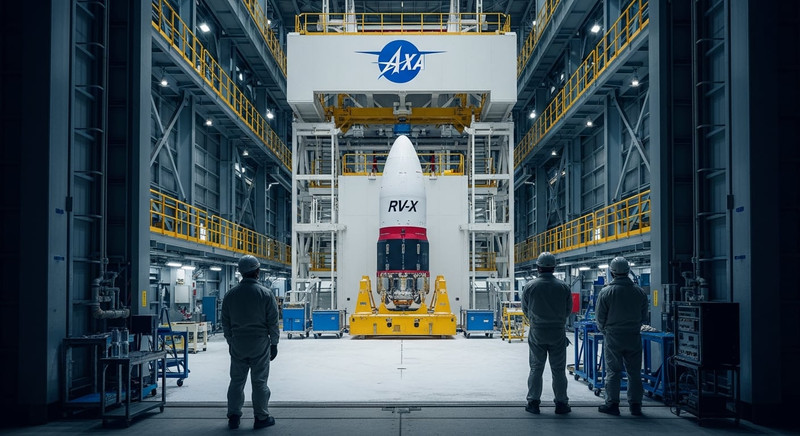
JAXA's RV-X Reusable Rocket Successfully Completes First Flight
Japan's space agency JAXA successfully tested its RV-X prototype, a critical step towards reducing costs and boosting competitiveness in the global space market.
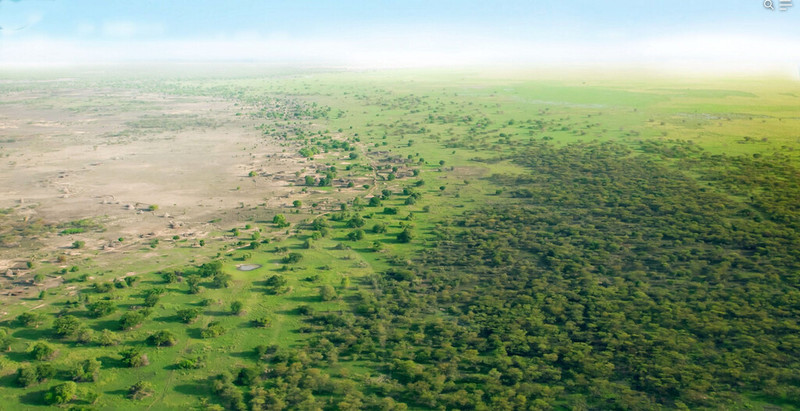
China's Great Green Wall: Artificial Forests Outpace Natural Growth
China planted 66 billion trees over nearly half a century to combat desertification, and a new study shows they grow faster than natural forests, albeit with important nuances.
Latest news
View all
MIT Chip Converts Invisible Infrared Light into Crucial Data
MIT researchers developed an innovative chip detecting methane and propane using mid-infrared light, with potential for millions of pixels and optical computing.
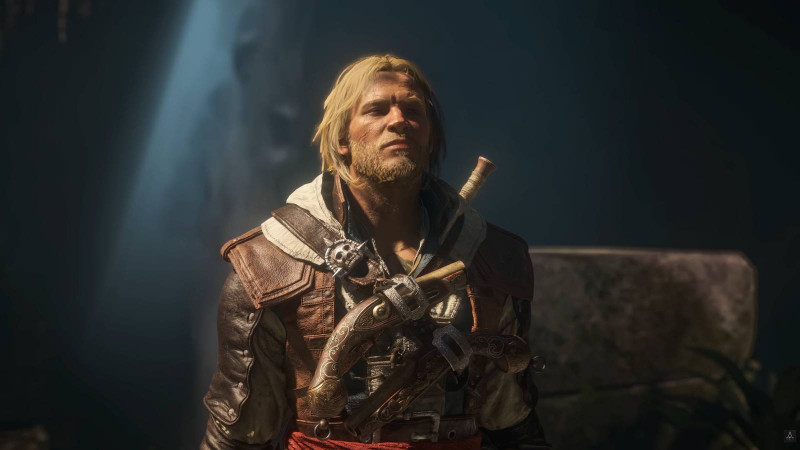
Assassin's Creed Black Flag Resynced Smashes 3 Million Sales, New Game Plus Announced
Ubisoft's successful re-release of the pirate classic continues to break records, confirming one of the most requested features from the gaming community.

TikTok tests AI tool to protect creators from deepfakes
The video platform is rolling out an opt-in feature allowing users to verify their identity and report unauthorized AI-generated likenesses.
Comments (0)
No comments yet. Be the first!
Only registered readers can comment.